


The Car 4 Ukraine Journey: We Delivered the Truck… But the Fight Isn’t Over

Mar 24
11 min read
Updated: Apr 13

When I first decided to drive a battle-ready Toyota Hilux from London all the way to Ukraine, I knew it was going to be one of the most important things I’d film this year. I’ve been connected to Ukraine since 2013, I was a Kyiv Resident between 2021 and 2022, and I still have friends on the front line. This wasn’t about making content. It was personal.
It all started while I was standing in the warm sunshine of beautiful Malaga. Normally, I’d be filming a relaxed “24 hours in Malaga” or “one week in Malaga” vlog, but that day it just didn’t feel right. Instead, I looked straight into the camera and told everyone the truth: I’d made the decision. I was flying back to London, picking up a tough Toyota Hilux that had been donated to the charity, and driving it myself all the way to Ukraine to hand it over to the volunteers at Car 4 Ukraine. That video was the spark — the moment I said it out loud, there was no turning back. The moment when I was asking strangers and people I called friends or family to dig into their pockets and donate to a Charity called Car for Ukraine.
In the very first video, I sat in the van in London, packed and ready, and spoke honestly about how tired the world has become of hearing about Ukraine. I get the fatigue — it’s been years now. But as I drove toward Belgium, I spoke openly about the real fatigue so many people feel after four years of headlines, energy bills and endless news cycles. Some viewers had already unsubscribed, and I get it — life is hard enough at home. But as I drove toward Liège, I kept coming back to the same point: we can’t simply turn away when ordinary Ukrainians I’ve known since 2013 are still fighting for their survival.
The second full day on the road took me from Liège in Belgium deep into Germany, heading toward Giessen. As the kilometres ticked by, I used the long, quiet stretches to speak openly about something that had been weighing on me: how history repeatedly warns us what happens when we ignore aggression and allow societies to slowly collapse. I drew a direct parallel with Lebanon — a country that was once tolerant, liberal, and welcoming to everyone, until civil war tore it apart. The message was clear and uncomfortable: ignoring warning signs today could lead Europe down the same dangerous path. All the while, the Hilux sat heavy in the back of my mind. This wasn’t just another road trip. I was carrying a truck that would soon be armoured and sent straight to the front line in Ukraine to evacuate wounded soldiers and deliver life-saving supplies. Every mile I drove east made the mission feel heavier and more urgent.
I left Giessen early and drove the long stretch toward Dresden. As the kilometres rolled by, I couldn’t stop thinking about what happened to this city in 1945. I stopped in Dresden and walked through the rebuilt old town, stood where the firestorm had raged, and spoke openly about the horror of the bombing — the tens of thousands of civilians killed in a single night, the city reduced to rubble and ash. The contrast hit me hard: today the streets are beautiful and peaceful again, yet just a few hundred kilometres further east, another war is destroying lives in real time. I drew the uncomfortable parallels between 1945 and what’s happening in Ukraine right now — the deliberate targeting of civilians, the destruction of homes and heritage, and the way history keeps warning us what happens when aggression is left unchecked. Driving through modern Dresden while carrying a truck destined for the Ukrainian front made the whole journey feel heavier. It was a quiet but powerful reminder of why this mission matters.
The leg from Dresden to Wrocław turned into a complete nightmare. Heavy snow had turned the A4 motorway into a skating rink. Within hours, I counted at least 10 separate accidents — cars spun out, lorries jack-knifed, and emergency services struggling to keep up. Progress was painfully slow; at one point, I barely moved more than a few kilometres in an entire hour. The Hilux handled it better than most, but even she was sliding and struggling. I sat there for hours with the engine running and heater on full, watching the chaos unfold through the windscreen while the reality of the mission sank in deeper. Every minute of frustration reminded me why I was doing this: if I was struggling this much just to get one truck through Europe in winter, imagine what the volunteers on the front line face every single day in far worse conditions. That’s exactly why every donation to Car 4 Ukraine matters — because these trucks become lifelines when conditions are at their worst. The snow chaos only made me more determined to get that Hilux to Lviv.
After the absolute nightmare of the previous day’s snow chaos, I left Wrocław in the morning and headed east toward the Ukrainian border. What I thought would be another long, tiring drive turned into one of the most pleasant surprises of the whole journey. I ended up stopping in Tarnów — a stunning, underrated Polish city that most travellers completely miss. I wandered its peaceful cobbled streets, admired the beautiful historic architecture, the vibrant (even in winter) market square, and the rich sense of heritage. Despite the snow still falling and the cold biting, the city felt calm, proud, and genuinely welcoming. I explored the old Jewish quarter, stood in front of the Gothic basilica, admired the statue of national poet Adam Mickiewicz, and learned about local heroes like General Józef Bem. It was the perfect breather after the frustration of the road. As I walked around, I kept thinking how this hidden gem showed the best of Poland — clean, proud, and full of quiet dignity. And all the while, the mission stayed front and centre: this Toyota Hilux I was driving still needed to reach Lviv so it could be armoured and sent to the 82nd Assault Brigade in Pokrovsk to evacuate wounded soldiers and deliver vital supplies.
Leaving the quiet beauty of Tarnów behind, I pushed further east and arrived in Rzeszów — a city I knew little about but quickly fell for. I wandered its historic streets, admired the elegant old town square with its Kościuszko statue, explored beautiful churches that had survived centuries of war and occupation, and stood in front of a moving WWII memorial where fresh flowers still lay in February. What struck me most wasn’t just the architecture or the spotless streets — it was the unmistakable Polish spirit. These people understand sovereignty, national pride, and resistance in a way that feels almost lost back home in Britain. While we argue endlessly about politics that serve no one but the machine itself, the Poles seem to know exactly who they are and what they’re willing to fight for. I spoke openly about the mess in UK politics in 2026 — the disconnection from Westminster, the failed promises, and why I envy Poland’s clarity on good versus evil. As I walked through Rzeszów that evening, eating ribs and soaking in the atmosphere, it hit me hard: Poland still remembers what many in the West have quietly surrendered. And right now, that same unbreakable spirit is exactly what’s keeping Ukraine alive just across the border. This drive isn’t just about delivering a truck — it’s about standing with people who refuse to give up.
After 1,250+ miles of snow, ice, rain, and endless motorway, I finally reached the Polish-Ukrainian border. The crossing was slow and bureaucratic — paperwork, car registration, long stares from officials — but the moment I drove across and saw the Ukrainian flag again, a wave of emotion hit me. “I’m back,” I said to the camera, and it felt real. On the rocky, potholed roads heading toward Lviv, I spoke openly about the fury building across Europe over mass migration and demographic change — how countries like Britain have seen their population shift dramatically in just a few years, and why so many people are quietly angry. Yet here in Ukraine, men and women are fighting a visible enemy every single day for their homes, their families, and their right to exist. The contrast was stark. Later that evening in Lviv, I sat down to what I honestly called the best ribs on earth — smoky, tender, and full of flavour — and raised a glass with some locals and mercenaries. In the middle of a country at war, people were still living, laughing, and showing incredible warmth. That mix of heavy truths and small human moments is exactly why I made this drive.
I stood alone in Lviv’s historic Field of Mars cemetery, surrounded by graves from centuries of Ukrainian struggle against invaders and occupiers. The final resting place of Ukraine’s bravest sons and daughters. What used to feel like a quiet, solemn place years ago now feels heavy and overwhelming. Row after row of fresh graves stretch out in front of me: young men and women born in the 1980s, 1990s, 2000s, and even into the 2020s, their lives cut brutally short between 2022 and 2025. Black and white stones, fresh flowers, and dates that end far too soon. As I walked among them, my stomach sank. I traced centuries of Ukrainian suffering — from Cossack uprisings and foreign partitions, through the man-made Holodomor famine that killed millions, the brutal guerrilla wars against both Nazis and Soviets, decades of Soviet repression, the Maidan revolution, and now this full-scale invasion. These people didn’t die for glory or politics. They stood because the alternative was watching their homes burn with their families inside. When the border was crossed, when the bombs fell, when the children screamed — they picked up a gun, a bandage, or the wheel of a truck like the one I just delivered. They had no choice but to fight for the right to exist in their own land. Standing there with the graves multiplying, I felt the weight of it all: this isn’t history in a museum. This is a living ledger, and the sum is still rising. Yet through it all, Ukrainians refuse to break. That unbreakable spirit is exactly why this cause still matters so deeply.
After all those long, exhausting days on the road, the moment finally arrived in Lviv. I handed over the battle-ready Toyota Hilux to the incredible team at Car 4 Ukraine. Watching them immediately start prepping it — bolting on heavy armour plating to the doors and bonnet, adding protection for the windows and seats, and fitting a drone jammer on the front — brought a huge wave of relief mixed with humility. This tough little truck, which I’d driven all the way from London, would soon be heading straight to the frontlines near Kramatorsk to evacuate wounded soldiers, deliver vital supplies, and support Ukraine’s defenders. I met dedicated volunteers like Anton, who has been driving aid vehicles to the hottest zones for four years, and Ivan Oleksii, one of the co-founders. Hearing their stories and seeing the quiet determination in their eyes reminded me of why this matters so much. The smiles and the Ukrainian flag they gave me felt incredibly special, but as the flag waved, the sobering truth hit home: one truck is delivered, but the war rages on, and the real work is only just beginning. Every single vehicle like this saves lives, and the need is still urgent.
That Same Evening in L'viv...
Just hours after I handed over the Hilux and watched the team begin armouring it for the front line, I was walking back through the centre of Lviv when the night exploded. A massive blast ripped through the city just two blocks from the opera house, followed seconds later by a second explosion as emergency services rushed in. Shrapnel flew, people screamed, and the street turned to chaos in an instant. I stood there, only 10–20 metres away, filming the horror I never expected to witness: a young policewoman killed, officers and civilians injured, the smell of explosives still hanging in the cold air. What was meant to be a moment of quiet relief after the delivery became a raw reminder of the reality Ukrainians face every single day. This wasn’t a missile or drone — it was a deliberate terrorist attack on the ground, in a city most people consider “safe” in western Ukraine. Yet for the people living here, this is normal. They go to sleep knowing any night could bring explosions, fear, and loss. Standing there in the aftermath, heart pounding and camera shaking, I realised more than ever: while I could walk away and return to a peaceful life, Ukrainians have no such luxury. They live with this danger every single day — and still they refuse to break.
All advertising revenue from every single video in this series goes 100% to Car 4 Ukraine. No cuts, no overheads, no middlemen — every penny goes straight to the cause.
Right now, in March 2026, the war is still raging in the east. Ukrainian soldiers and volunteers are fighting desperately to hold the line and evacuate the wounded under constant fire. Reliable, armoured vehicles like the Hilux I just delivered are not luxuries — they are lifelines. They’re used as makeshift ambulances to pull injured fighters out of danger zones, to deliver critical supplies to the front, and to keep units mobile when every other option has been destroyed. Each vehicle can save up to 40 lives. That’s not a statistic. That’s fathers, sons, brothers, and husbands who get to see their families again because a simple truck was there when it mattered.
The need has not gone away just because one truck has been delivered. The frontline still desperately needs more. That’s why this campaign remains wide open and every single donation — whether £1, €5, $10 or more — still makes a real, tangible difference.
If you’ve already donated, thank you again from the bottom of my heart. You helped get that Hilux to Ukraine. If you haven’t donated yet or feel you can give a little more, please consider helping us get the next vehicle ready. Every pound, every euro, every dollar goes directly toward buying, preparing, and armouring the next truck that will head to the front.
Donate here and help save more lives: https://car4ukraine.com/en-US/campaigns/the-wondering-englishman
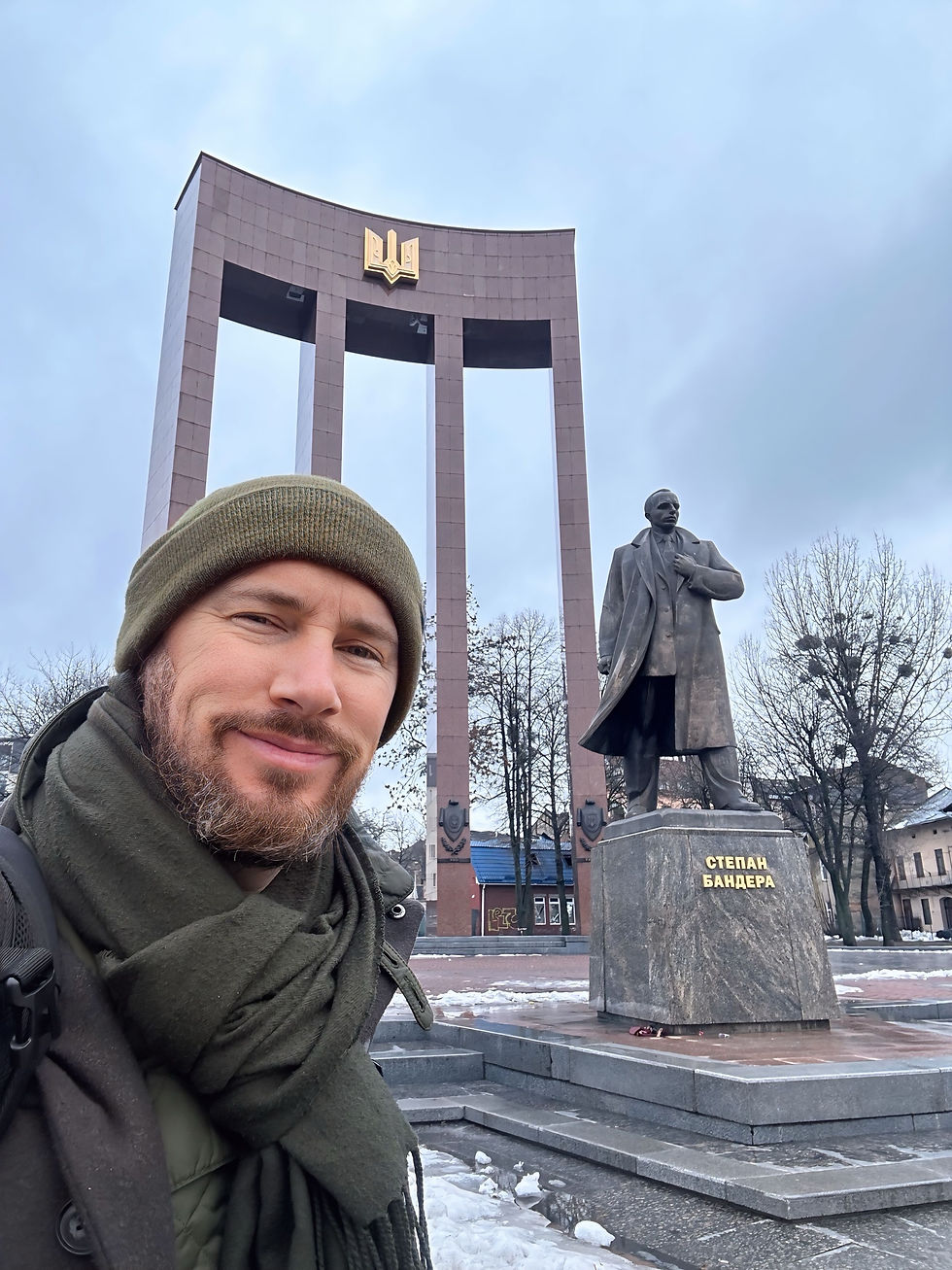
With the Toyota Hilux safely handed over and the shocking events of that evening still echoing through the city, I stepped back out onto the streets of Lviv the next day. What I captured in this video is something I wanted viewers to feel for themselves: the extraordinary resilience of one of Ukraine’s most beautiful historic cities as daily life continues amid the ever-present reality of war. I walked through the cobbled squares, past the dimly lit Opera House, saving power in case of another strike, past the church recently hit by an Iranian drone, and up to the old citadel on Shevchenko Hill. Air-raid sirens sounded, locals carried on with quiet determination, and the contrast between breathtaking architecture and the heavy weight of conflict was impossible to ignore.
I’m heading off to Normandy next, but Ukraine will never leave my thoughts. I’ll keep telling these honest stories because the world must remember: this fight is still going on, and ordinary people like us can still make a real, tangible difference. Slava Ukraini. Stay wondering.
Alex - The Wondering Englishman


Comments